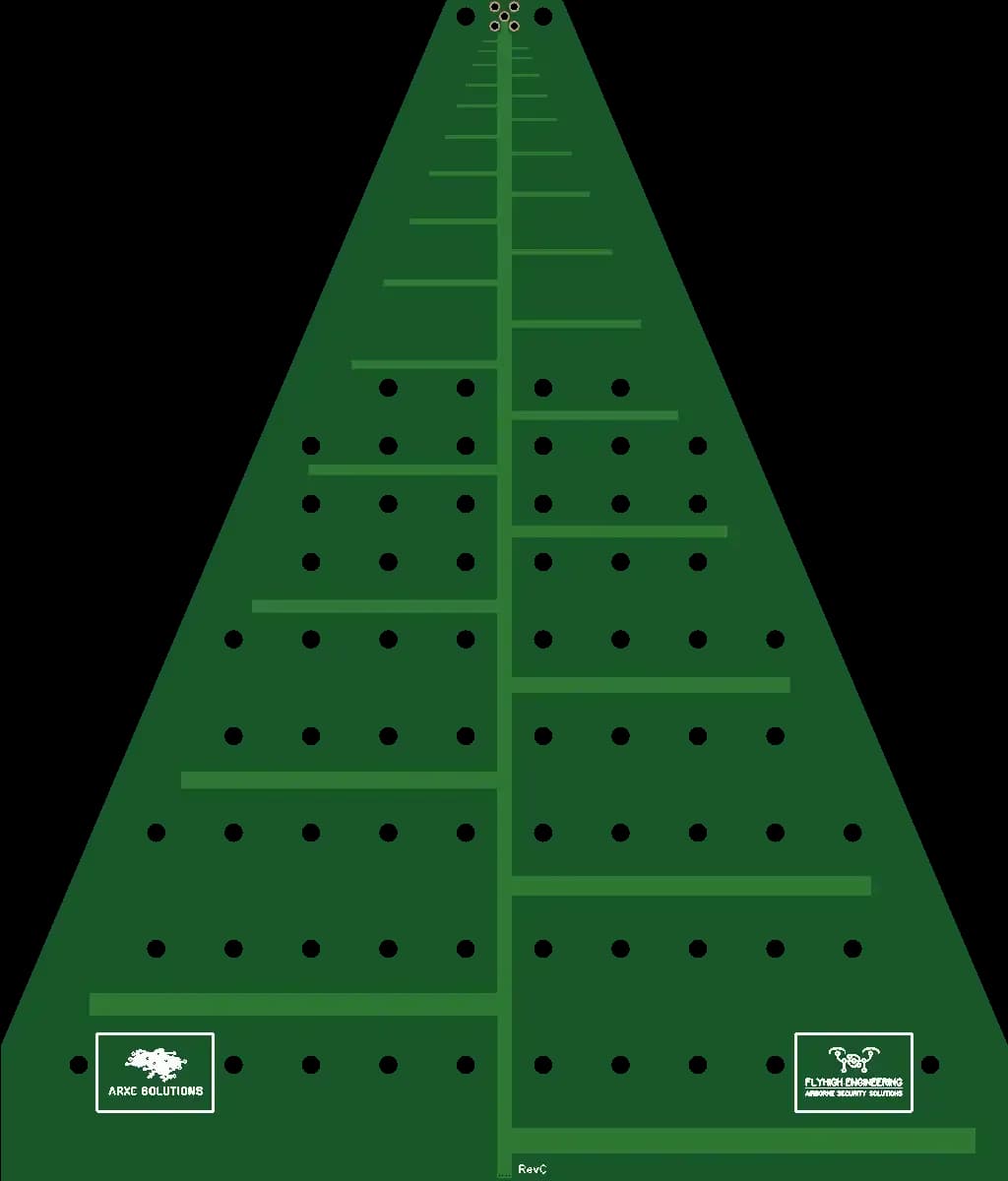
Log-periodic antenna 300–6000 MHz
Directional log-periodic PCB antenna, 300–6000 MHz: from 433 MHz and PMR up to 5.8 GHz on one antenna, with no retuning. The 500 × 430 mm board is exactly what working from 300 MHz requires. The larger model in the range.
Specifications
| RF | |
|---|---|
| Antenna type | Log-periodic directional |
| Working range | 300–6000MHz |
| Purpose | Signal reception / transmission |
| Radiation pattern | Directional |
| Tuning | No manual tuning required |
| Compatibility | Transceiver modules in the corresponding band |
| Mechanical | |
| Construction | Printed PCB antenna |
| Height | 500mm |
| Width (bottom) | 430mm |
Description
The 300–6000 MHz log-periodic antenna spans a twenty-to-one frequency range: 300 MHz to 6 GHz on a single directional antenna, with no retuning and no swapping for each job. This is the larger model in the range — it sees what the 530–6000 MHz version cannot.
What those 230 MHz at the bottom buy you
The gap between 300 and 530 MHz looks small until you look at what sits inside it. This is one of the busiest stretches of spectrum there is:
- 433 MHz ISM — telemetry, LoRa, remote controls, sensors
- 430–440 MHz — the amateur UHF band
- 446 MHz PMR — handheld radios
- 300–400 MHz — service and departmental channels
- 470–530 MHz — the lower DVB-T television channels
If none of those frequencies matter to your work, the compact 530–6000 MHz model is enough and costs half as much. If even one of them does, this antenna has no substitute — and that is what you are paying for.
Why it is bigger
The lowest frequency of a log-periodic antenna is set by its longest element: roughly half a wavelength. At 300 MHz the wavelength is a metre, so the element comes out at about half of that — hence the 430 mm width at the bottom of the board and the 500 mm height. For comparison, the 530–6000 MHz model gets by on 260 mm, because its wavelength is nearly half as long.
That is physics, not marketing: an antenna that works from 300 MHz cannot be small. The board area here is roughly three times larger, which is where the price difference comes from.
Direction instead of power
The antenna listens where it points and hears markedly less from the sides and behind. In crowded spectrum that often decides more than gain: a strong neighbouring transmitter falls outside the main lobe and stops swamping the receiver. Rotating the antenna also gives you the direction to a source — a basic move in radio monitoring and transmitter hunting.
Who it suits
- radio monitoring and direction finding across everything from UHF to 6 GHz
- SDR setups: one antenna for every scanning job
- work with 433 MHz telemetry and control links
- DVB-T reception alongside the rest of the spectrum
- fixed spectrum-monitoring posts
- laboratory measurements and RF equipment testing
Construction
The antenna is built on a printed circuit board with a log-periodic conductor structure, each section responsible for its own part of the band. Printing delivers repeatability — the next unit performs like the last one, with no hand-picked elements.
The board carries an RF connector area and mounting holes for a bracket, an enclosure or your own product. Do account for the size: 500 × 430 mm is a fixed or mast-mounted format; for a backpack the smaller model is the easier companion.
Measurements
We measured the radiation pattern in an anechoic chamber and published it in full: the report with 2D and 3D plots opens straight in the browser and can be rotated and zoomed. What we show is our own measurement, not a figure from someone else's datasheet.
If the lower frequencies are not needed, compare it with the 530–6000 MHz log-periodic antenna — smaller and half the price. Not sure which of the two you need? Send us the list of frequencies you work with and we will advise.
Test results
Buying in volume? The price changes
Volume pricing is worked out against your quantity. Tell us how many units you need and we will come back with a calculation within one business day.
- Pricing scales with volume
- Delivery across Ukraine
- Reply within a business day
Frequently asked questions
- How does this differ from the 530–6000 MHz model?
- It works from 300 MHz rather than 530, so it additionally sees 433 MHz ISM, 446 MHz PMR, the amateur UHF band and the lower DVB-T channels. That makes the board bigger — 500 × 430 mm against 305 × 260 mm — and more expensive. If you do not need the lower frequencies, take the compact model.
- Why does it cost twice as much as the smaller model?
- Size. The lower band edge is set by the longest element — roughly half a wavelength, which at 300 MHz is about half a metre. The board area works out roughly three times larger than on the version starting at 530 MHz.
- Is it suitable for handheld or portable use?
- A 500 × 430 mm board is really a fixed or mast-mounted format. For portable work the 530–6000 MHz log-periodic antenna is easier to carry, if its band is enough for you.
- Does it need tuning for a specific frequency?
- No. The log-periodic structure works across the whole band at once, with no element picking. It is ready as soon as it is connected to a receiver, transmitter or SDR.
Reviews
No reviews yet. Be the first to leave one.