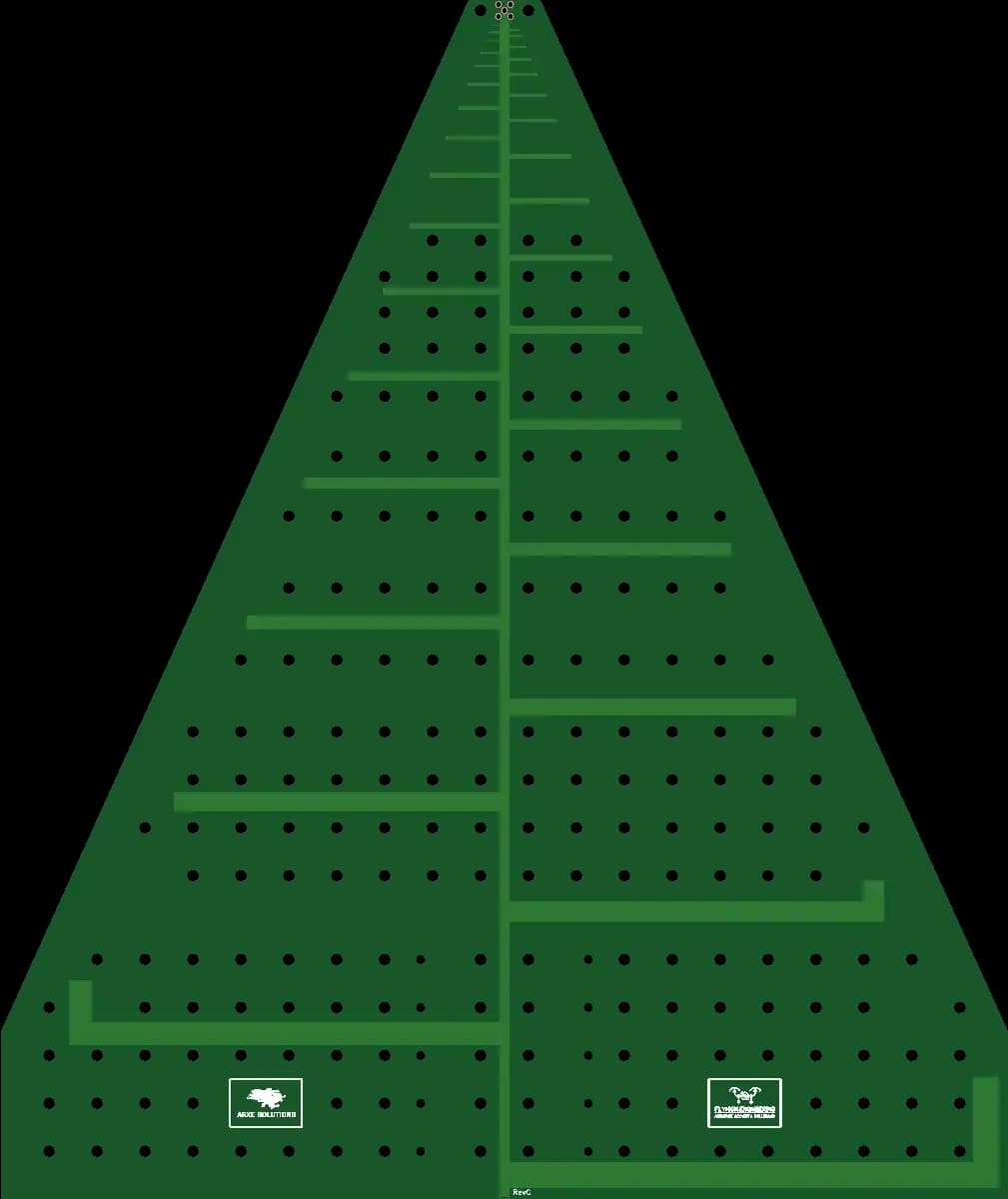
Log-periodic antenna 530–6000 MHz
Directional log-periodic PCB antenna, 530–6000 MHz: one antenna instead of a set of narrowband ones, from UHF up to 6 GHz. Compact at 305 × 260 mm and needs no tuning. The smaller model in the range — if you need below 530 MHz, see the 300–6000 MHz version.
Specifications
| RF | |
|---|---|
| Antenna type | Log-periodic directional |
| Working range | 530–6000MHz |
| Purpose | Signal reception / transmission |
| Radiation pattern | Directional |
| Tuning | No manual tuning required |
| Compatibility | Transceiver modules in the corresponding band |
| Mechanical | |
| Construction | Printed PCB antenna |
| Height | 305mm |
| Width (bottom) | 260mm |
Description
The 530–6000 MHz log-periodic antenna covers everything above UHF: service channels, 868 MHz ISM, 2.4 and 5.8 GHz. One directional antenna replaces a set of narrowband ones and never needs retuning — wherever in the band the signal sits, the antenna is already listening.
This is the compact model in the range: 305 × 260 mm against 500 × 430 mm for the 300–6000 MHz version, at half the price. If your frequencies start at 600–700 MHz and up, the larger board buys you bandwidth you will not use.
What lives in 530–6000 MHz
- 700, 800 and 900 MHz — mobile networks, service channels, 868 MHz ISM
- 1.2 and 1.3 GHz — analogue and digital FPV channels
- 1.5 GHz — satellite navigation signals
- 1800 and 2100 MHz — mobile bands
- 2.4 GHz — Wi-Fi, Bluetooth, FPV, telemetry, control links
- 5.2 and 5.8 GHz — Wi-Fi and the main FPV band
Below 530 MHz the antenna does not work. That matters if your job involves 433 MHz (telemetry, LoRa, remotes), 446 MHz PMR, the 430–440 MHz amateur band or the lower DVB-T channels from 470 MHz — those need the 300–6000 MHz version.
Why the board is this size
The longest element of a log-periodic antenna sets its lowest frequency: it has to be roughly half a wavelength. At 530 MHz the wavelength is about 566 mm, so the longest element works out at about 283 mm. That is where the 260 mm width at the bottom of the board comes from.
It is not an arbitrary figure: going down to 300 MHz stretches the wavelength to a metre and the element to half of that, and the board inevitably grows and costs more. This model's compactness is a direct consequence of where its band starts.
Direction instead of power
A log-periodic antenna listens where it points and hears markedly less from the sides and behind. In a crowded urban spectrum that often matters more than gain: the neighbouring transmitter that was swamping your reception simply falls outside the main lobe. Rotating the antenna also tells you the direction to a source — a basic move in radio monitoring.
Who it suits
- SDR receivers and transceivers — scan the spectrum without swapping antennas
- FPV: 1.2, 2.4 and 5.8 GHz ground stations on a single antenna
- radio monitoring and direction finding
- lab benches and RF equipment testing
- portable kits where weight and size count
Construction
The antenna is built on a printed circuit board: the log-periodic conductor structure is calculated so each section works on its own part of the band. Printing delivers what a production run needs most — repeatability: the next unit performs like the last one, with no hand-picked elements.
The board carries an RF connector area and mounting holes, so it can go on a bracket, into an enclosure or inside your own product. The flat shape travels well and mounts easily on a mast.
Measurements
We measured this antenna's radiation pattern in an anechoic chamber and published it in full: the report with 2D and 3D plots rotates and zooms straight in the browser. The figures in the specification come from our own bench, not from a supplier datasheet.
Need a lower band? See the 300–6000 MHz log-periodic antenna. Need an omnidirectional pattern instead of a directional one? The catalogue has broadband disc antennas. Not sure which fits — send us the conditions and we will advise.
Test results
Buying in volume? The price changes
Volume pricing is worked out against your quantity. Tell us how many units you need and we will come back with a calculation within one business day.
- Pricing scales with volume
- Delivery across Ukraine
- Reply within a business day
Frequently asked questions
- How does this differ from the 300–6000 MHz model?
- In the lower band edge, and therefore in size and price. This one starts at 530 MHz on a 305 × 260 mm board; the larger model starts at 300 MHz on 500 × 430 mm. If your work involves 433 MHz, 446 MHz PMR or the lower DVB-T channels, you need the 300–6000 MHz version.
- Will it receive 433 MHz?
- No, that is below its working range. For 433 MHz you need the 300–6000 MHz log-periodic antenna.
- Does it need tuning for a specific frequency?
- No. The log-periodic structure works across the whole band at once — no element picking, no adjustment. It is ready as soon as it is connected to a receiver or SDR.
- Can it be used for transmission?
- Yes, it is designed for both reception and transmission. Agree the power level for your specific case — send us the conditions and we will advise.
Reviews
No reviews yet. Be the first to leave one.