A drone shows up in the spectrum before it shows up in the sky
The first thing you learn at a position is not to watch the sky. The sky tells you too late. By the time an FPV is within your line of sight, the count is in seconds — and you spend those seconds on reflex, not on a decision.
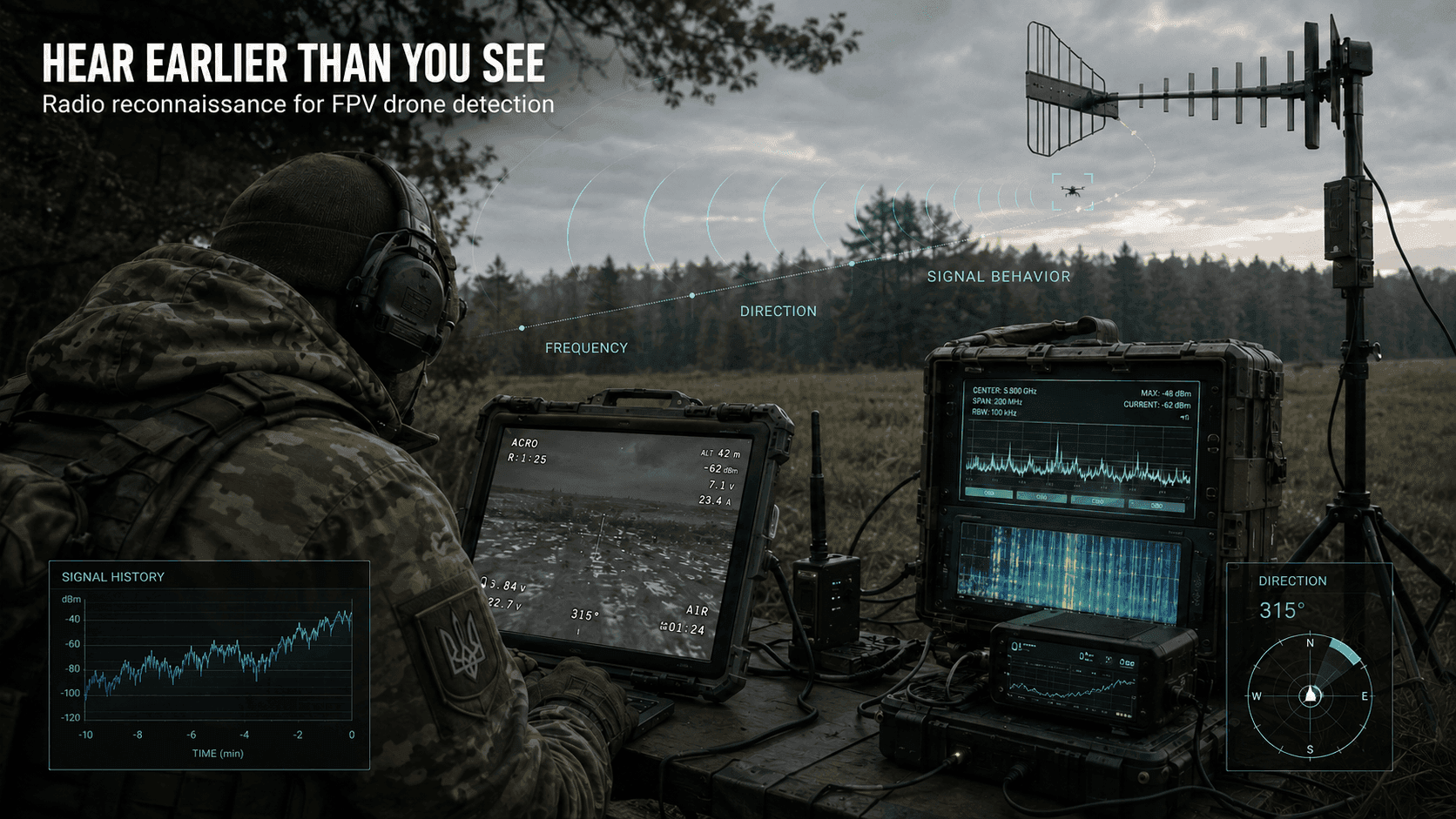
The spectrum speaks earlier. A drone still gaining altitude somewhere beyond the treeline has already entered the radio spectrum: its video transmitter is on, the picture is going to the operator, and that picture does not live only on someone else’s screen. It is in the air. It can be heard.
That shift — from looking to listening — is what the whole counter-air logic of the past few months is built on.
Why standard solutions hit a ceiling
Analog video receivers do exactly what they were built for: show a picture on a fixed set of channels. The problem is not them — it is that the enemy stopped playing by the rules of fixed channels. Frequencies shift. The ether is masked. Deliberate noise appears in the spectrum to make interception harder.
The result is a chase where you are always a step behind: to reach a new band you have to physically swap or buy more hardware. And while the new board is in transit, the band has already moved again.
The technical answer is simple in idea and far from obvious in execution: do not chase frequency with hardware — scan the spectrum in software. SDR is when the receiver is defined by code, not by a soldered filter. The width of the view stops being a property of a particular board and becomes a property of the software. The band shifted? You do not drive out for a new box — you just keep listening to the same span.
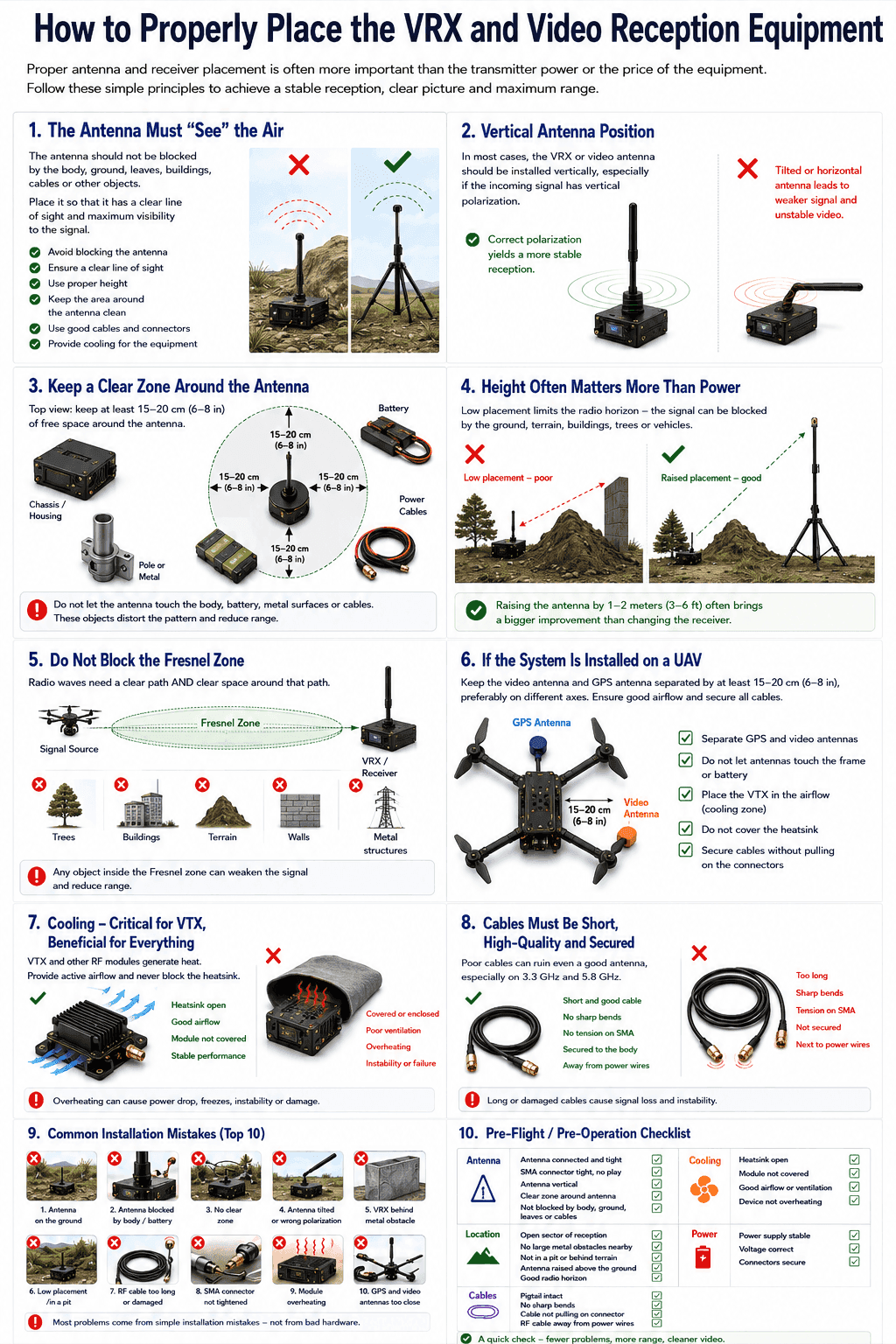
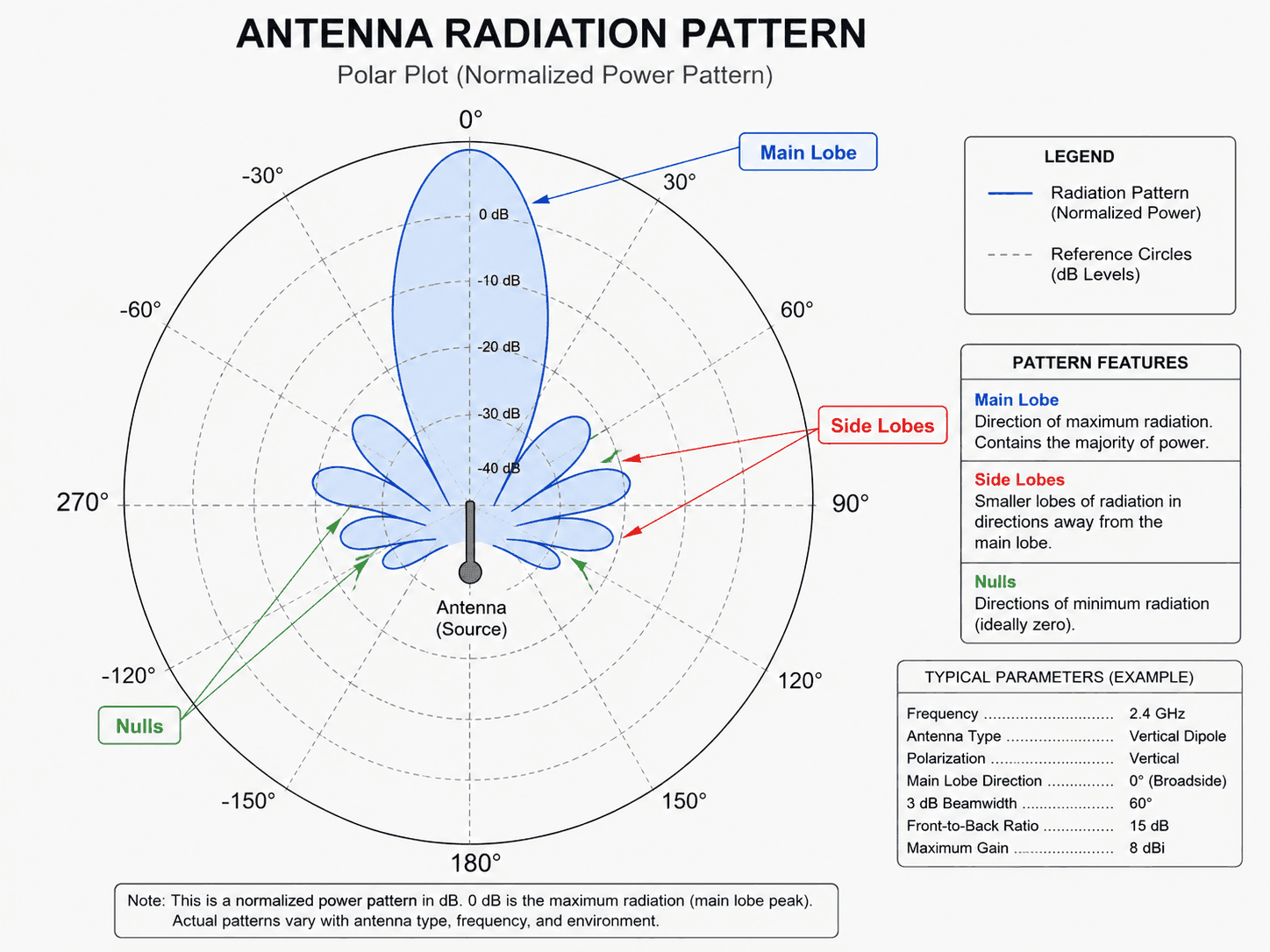
The other half of the answer is the antenna. An omnidirectional antenna hears everything and nothing at once: it drowns in noise. A directional antenna gives you what an omni cannot — direction. And once you have direction plus frequency plus how the signal behaves over time, an interception stops being merely there is a signal and becomes from over there, on this frequency, coming in like this.
What the operator actually sees
The most interesting part begins not at the hardware level but on the screen.
Intercepted FPV video is not just someone else’s picture. Over it runs the OSD: the telemetry the drone draws for itself. Altitude, heading, signal strength, the craft’s behaviour. For the operator that means a story is born out of the noise in the ether: here the craft climbed, here it turned onto its target, here is the movement pattern characteristic of a particular kind of flight.
This is the difference that is hard to put in a spec sheet. A radio signal on its own is an abstraction. Video with telemetry is situational awareness: an understanding of what is happening, from which side and how close, before the craft enters the field of view. The time you did not spend on reflex turns into time for a decision.
Spectrum reconnaissance is not one box — it is a way of working
There is one more thing that usually stays off-frame in polished presentations. A detection tool does not live in a vacuum. It lives where there are people, positions and risk.
So what matters is not only what it catches but how it stands. The ability to move the operator away from the station itself. The ability to work without external internet, locally, when there simply is no channel. The ability to pass the data onward — to those who make decisions, not just to one soldier by the antenna. And a quiet but important detail: less of your own emission means less chance the detection tool itself becomes a target.
This is no longer about a receiver’s characteristics. It is that radio-spectrum reconnaissance has become its own discipline — with its own deployment tactics, its own trade-offs between sensitivity and visibility, its own tempo.
Honest about the limits
Radio reconnaissance does not empty the sky. It does not shoot down drones and does not replace the means to destroy them. It does something else, and does it well: it shortens the gap between something is in the air and we know what it is, where from and where to. In a war decided by seconds and sectors, that gap is expensive.
At ARXE we look at the spectrum as a sensor. Not as one more device in a case, but as a source of information that is already in the air around a position — you just have to learn to read it. That, in essence, is what we do.