Night Vision Technologies: What the Camera Really Does in the Dark
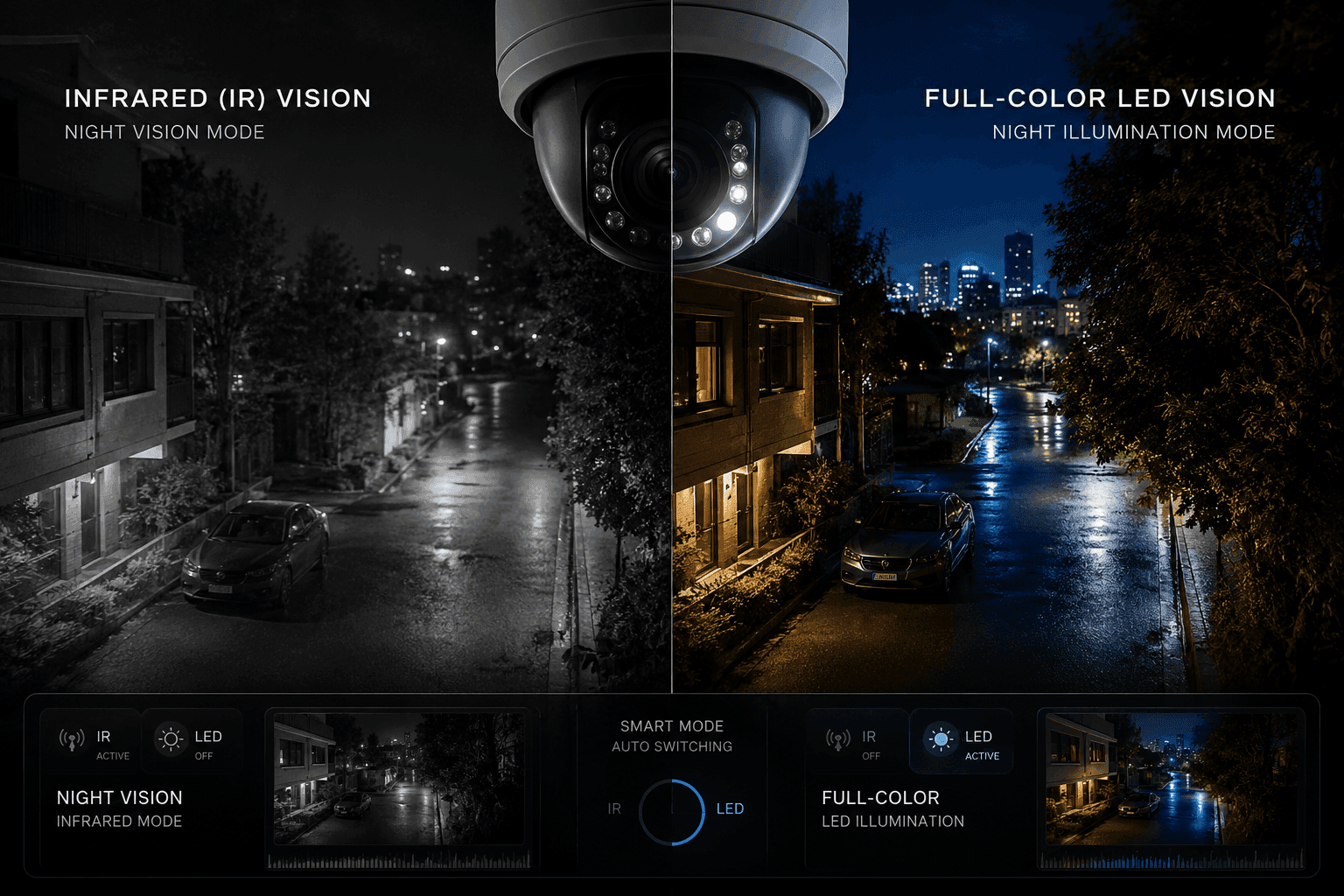
When I first started setting up systems for clients in genuinely challenging environments — densely built areas with poor lighting — what annoyed me most was the flickering that sometimes came even from good IR illumination. Choosing between IR and colour is always a trade-off between range and visual information density.
Let’s break down the fundamental distinction: infrared (IR) night vision versus what we see with the naked eye. IR illumination is the workhorse for true darkness: it uses wavelengths invisible to us, and the resulting image is black and white. On one hand you get maximum viewing range (on a budget, anywhere from 15 to 150 m on professional PTZ units), but remember: IR light often reflects off glass, dust, cobwebs, walls and the camera housing, creating glare — especially when the camera sits behind a window, where the illumination bounces back into the lens. For example, systems that run purely on IR in the 850 nm band (like the Hikvision DS-2CD1021-I-F — up to 30 m).
But sometimes we need colour. This is where full-color or LED illumination comes in, giving us what we’re used to seeing — colour video. It’s incredibly useful for identification: telling blue clothing from black, spotting a car’s make and model. There is, however, a big “but.” For this to work properly you need either powerful auxiliary lighting (already noticeable, and a source of complaints) or technologies that capture colour even in faint moonlight — using high-sensitivity sensors and large apertures.
Modern equipment often combines these approaches: automatic switching between invisible IR (for privacy) and visible LED (during an incident) is fairly common now. There’s also a white-light mode that shows a colour image, but its range can be shorter than pure IR, and it often creates noticeable glare.
For monitoring a small area — an apartment or a yard — I’d recommend cameras with high resolution (Full HD or 4K) and good hybrid illumination that switches between modes. If the budget allows and you need maximum colour without external lighting, look for models advertised for low-light performance (large sensors and a wide-aperture lens, like F1.0).
For a large area, combining systems is better: several fixed cameras for general coverage plus PTZ for detailed inspection (and thermal imaging if needed). When you need maximum range and don’t mind a black-and-white picture, look at powerful IR modules or laser systems (if you’re willing to pay for that technology and understand the risks of direct eye contact).
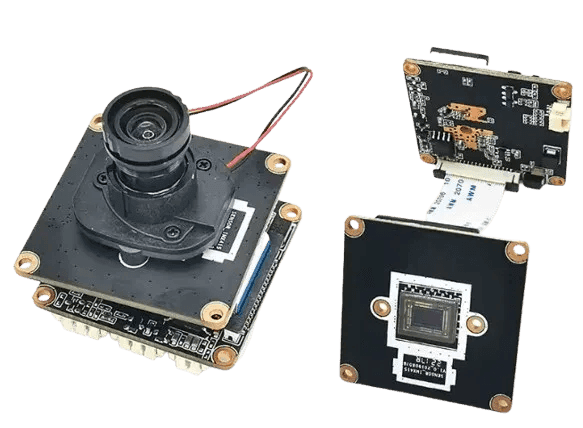
For flexible mid-range solutions, IP cameras work well — such as the module on the SSC338Q + Sony STARVIS IMX415. With even weak ambient light present, high-sensitivity cameras (a sensitive sensor plus wide optics) hold colour longer; in complete darkness they still need either white or IR illumination. It’s a more sophisticated solution, but it depends heavily on the specific location you’re recording.
Ultimately, I’d advise defining your priority: do you need maximum range, or colour identification?