How to choose an omnidirectional antenna for SDR
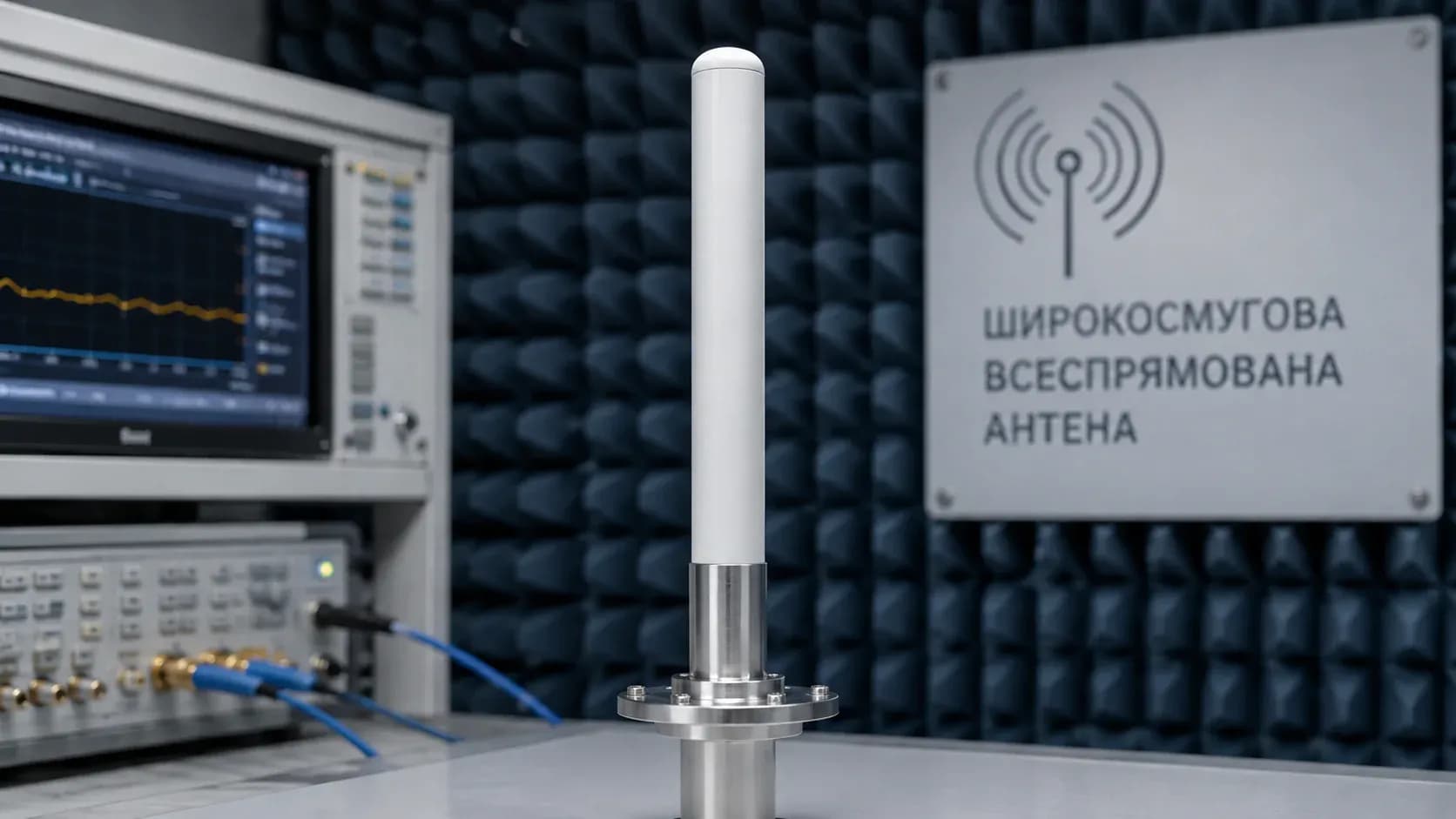
For SDR monitoring, an antenna is chosen by its lower frequency limit: the lower it reaches, the larger and heavier the antenna gets. That is the central trade-off, and it is where the choice should start — not with gain or price.
What an omnidirectional antenna gives you
An omnidirectional antenna receives from every direction in the horizontal plane, so it never has to be aimed. For spectrum scanning or standing watch that is decisive: you see the whole band, not a narrow sector.
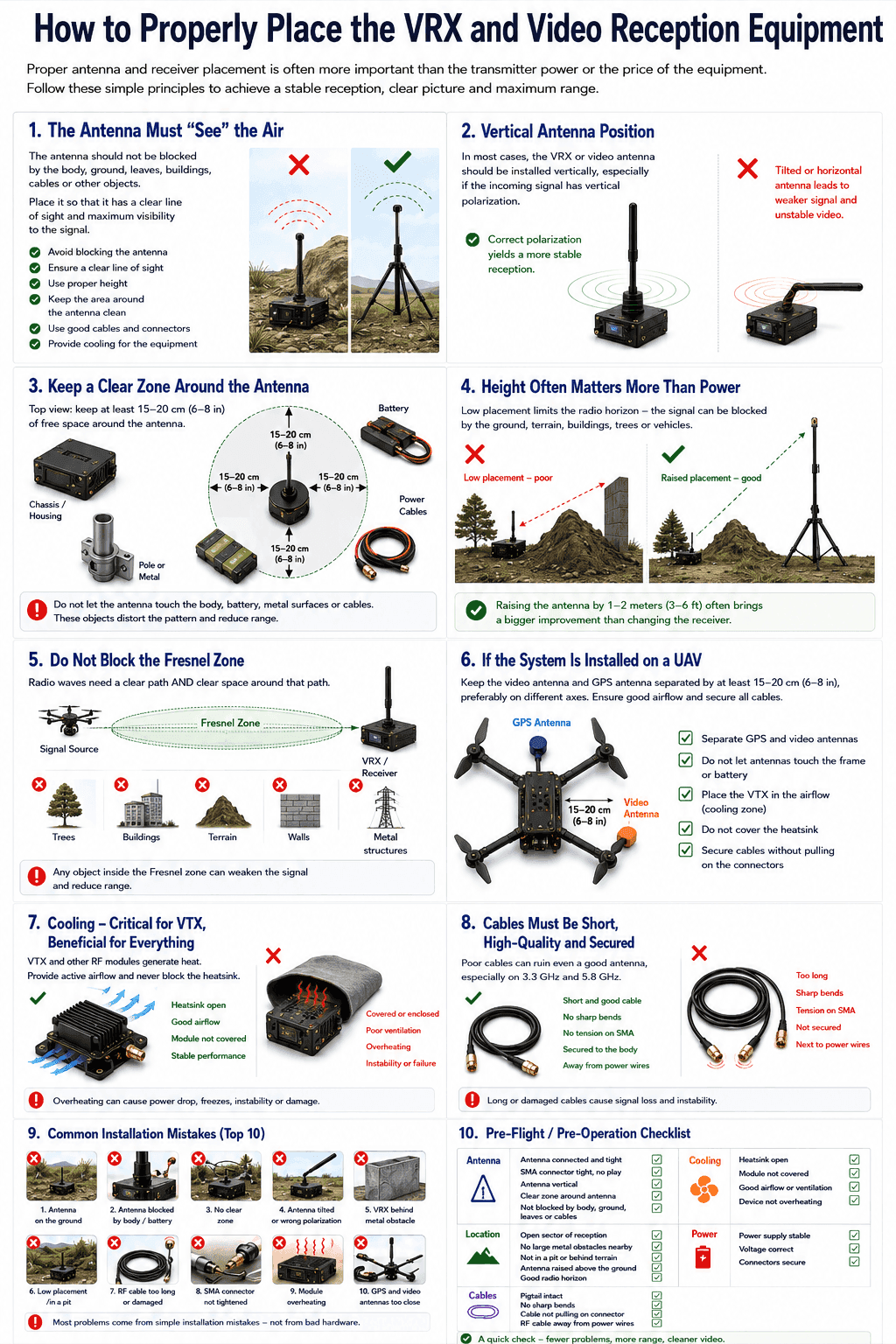
The price is lower gain than a directional antenna of the same band. If you already know the bearing and need range, a log-periodic will do better. Omnidirectional wins when the direction is unknown or the sources are many.
Where to start
Four parameters decide almost everything, in this order:
- The lower frequency limit — it sets the size. Physics does not negotiate: 300 MHz needs a bigger aperture than 800 MHz
- The connector — N-type is mechanically stronger and handles moisture better; SMA and RP-SMA are smaller but more fragile in the field
- Weight and dimensions — they decide whether the antenna travels or stays on a fixed mast
- Power rating — only matters if you intend to transmit; for reception alone it can be ignored
Three models, and how they differ
The comparison is easiest on three ARXE Solutions models: they cover different lower limits and show plainly what every extra hundred megahertz at the bottom costs.
Omni 1–8 GHz — the lightest
- Band: 1000–8000 MHz
- Gain: 8.8 dBi at 5800 MHz
- Connector: RP-SMA Male, 50 Ω, up to 200 W
- Size and weight: 120 × 120 × 100 mm, ≈100 g
Compact and inexpensive, but blind below 1 GHz. It fits work in the Wi-Fi and FPV bands: Omni 1–8 GHz disc antenna.
Omni 800 MHz – 8 GHz — the compromise
- Band: 800–8000 MHz
- Gain: 11.0 dBi at 5800 MHz
- Connector: N-type Female, 50 Ω, up to 500 W
- Size and weight: 210 × 210 × 180 mm, 360 g
The highest gain of the three at 360 g — this is the one you can actually carry with a mobile station: Omni 800 MHz – 8 GHz disc antenna.
Omni 300 MHz – 8 GHz — the widest
- Band: 300–8000 MHz
- Connector: N-type Female, 50 Ω, up to 500 W
- Size and weight: 330 × 330 × 350 mm, 1 kg
It reaches down to 300 MHz, so it sees the VHF and UHF the other two cannot. You pay for that with a kilogram and three times the volume: Omni 300 MHz – 8 GHz disc antenna.
The pattern is immediate: moving the lower limit from 1 GHz to 300 MHz multiplies the weight tenfold. If you do not need VHF and UHF, there is no reason to pay for them in bulk.
Common mistakes
The most frequent one is buying "headroom" at the bottom of the band that never gets used, then looking for somewhere to put a metre of hardware. The second is not checking the connector against the receiver: an adapter in the path adds loss exactly where you want none.
The third concerns polarisation. A linear antenna against a linear transmitter behaves predictably; against circular polarisation you lose roughly 3 dB, and that is physics rather than a fault.
How to check the result after installation
Measure SWR with an antenna analyser at several points across the band, not at a single frequency. Under 2:1 is acceptable for a wideband antenna; above that, look at the cable, the connector or the matching.
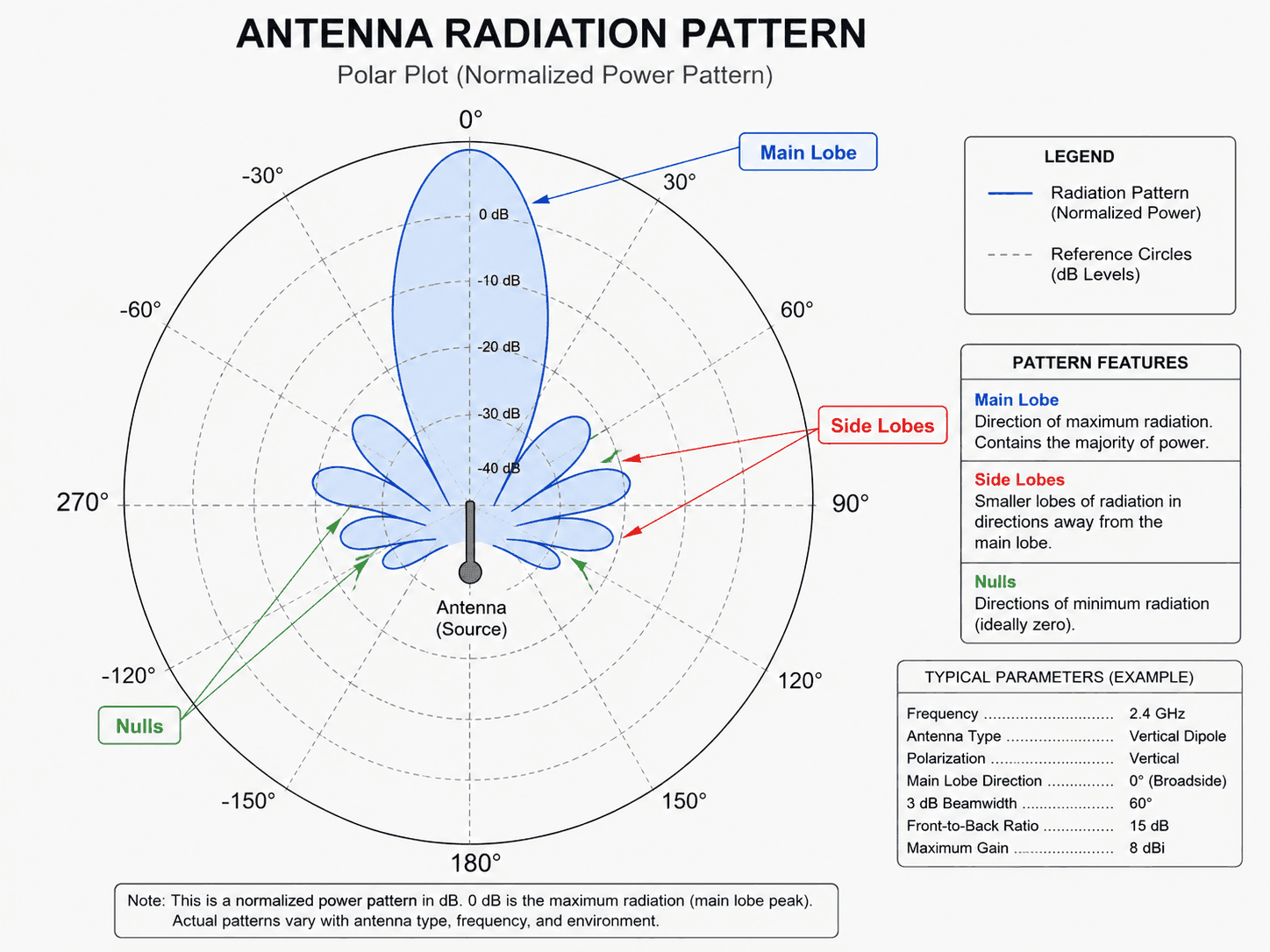
It helps to have something to compare against: our measurement reports carry full radiation patterns taken in an anechoic chamber, with photographs of the setup — you can see how the antenna behaves at every frequency, not just its quoted peak gain.
Frequently asked questions
Which antenna is better for general monitoring?
The omnidirectional one: it receives from all directions at once, so nothing is missed while you look for the bearing. A directional antenna makes sense once the source has been found.
Does an omnidirectional antenna need tuning?
It needs no mechanical tuning. Just check SWR after mounting — that catches problems with the cable and connectors rather than with the antenna itself.
Which model suits fieldwork?
The Omni 800 MHz – 8 GHz: at 360 g and 210 mm it genuinely travels. The 300 MHz – 8 GHz weighs a kilogram and stands 350 mm tall — that one is a fixed installation.
If you are unsure which lower limit to build around, write to us and we will match an antenna to your frequencies and mounting conditions.